
Web Development in 2026: The AI-Native, Server-First Era
The honest truth about web development in 2026 is that it has never been easier to build something, and never been harder to choose how. The ecosystem has expanded in every direction, with new frameworks arriving quarterly and AI tools fundamentally changing what developers spend their hours on.
If you started learning web development three years ago, some of what you learned is already considered legacy thinking. But if you're starting today, the tools are genuinely more powerful than any previous generation had access to.
Here is your definitive guide to the trends, tools, and philosophies shaping web development in 2026.
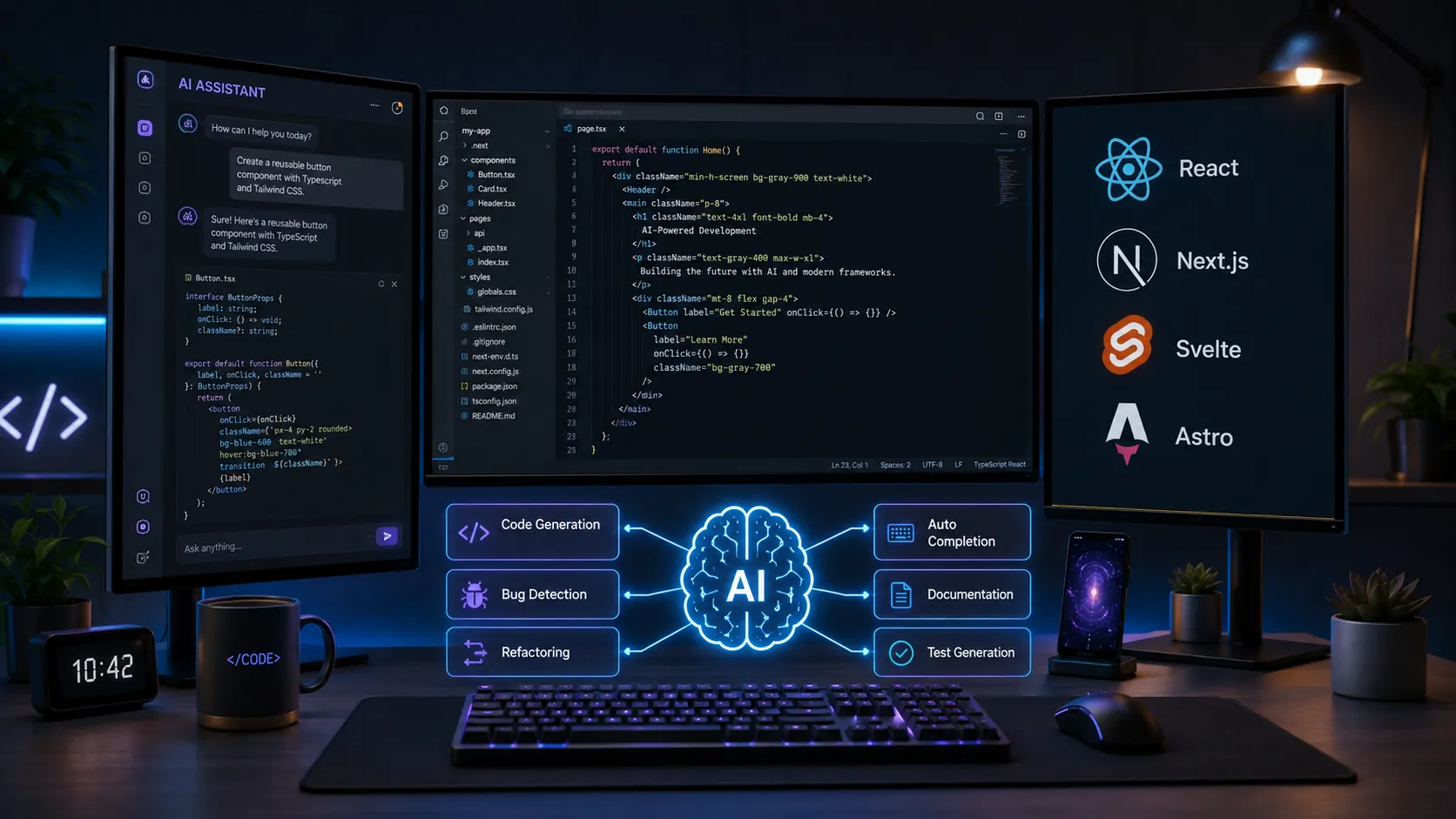
Image: The 2026 web development landscape is defined by AI-native workflows and a "server-first" philosophy.
The Big Picture: Three Forces Reshaping Everything
Three forces have converged to make 2026 feel fundamentally different from five years ago.
First, AI-assisted development became genuinely embedded in everyday workflows, not just a novelty. A majority of professional developers now use AI tools daily.
Second, performance became a revenue-relevant concern with measurable consequences. Core Web Vitals directly affect search rankings, and slow pages convert worse.
Third, composable architecture displaced monolithic thinking in serious teams, shifting the question from "which CMS should we use" to "which API should we connect."
These three forces combined to reshape not just which technologies developers use, but which philosophies they work from.
1. AI Is Now Embedded in the Development Workflow
Artificial intelligence is no longer an "add-on" feature. It is integrated into nearly every stage of web development.
AI-Assisted Coding: Developers now generate boilerplate code instantly, auto-complete complex functions, refactor legacy systems, and identify bugs in real time. AI tools like Copilot, Cursor, and Claude Code have measurably raised the floor for routine work — generating form validation logic, writing unit test scaffolding, or drafting a TypeScript interface from a JSON payload.
Vibe Coding: The rapid evolution of AI tools gave rise to "vibe coding" — a new, conversational, iterative way of building apps where the developer describes the desired product using natural-language prompts, while the LLM writes and refines the code.
From "Chatty AI" to "Agentic AI": The biggest leap in 2026 is the transition from passive AI that waits for a prompt to active agents that work in the background. A significant portion of code is now AI-generated, projected to reach even higher levels by 2027.
Productivity Gains: Research puts Copilot users at roughly 55% faster on well-scoped tasks. AI-assisted code completion has reduced time spent on boilerplate by around 40% for teams using strict TypeScript configurations.
2. The Frontend Landscape: React Dominates, Alternatives Rise
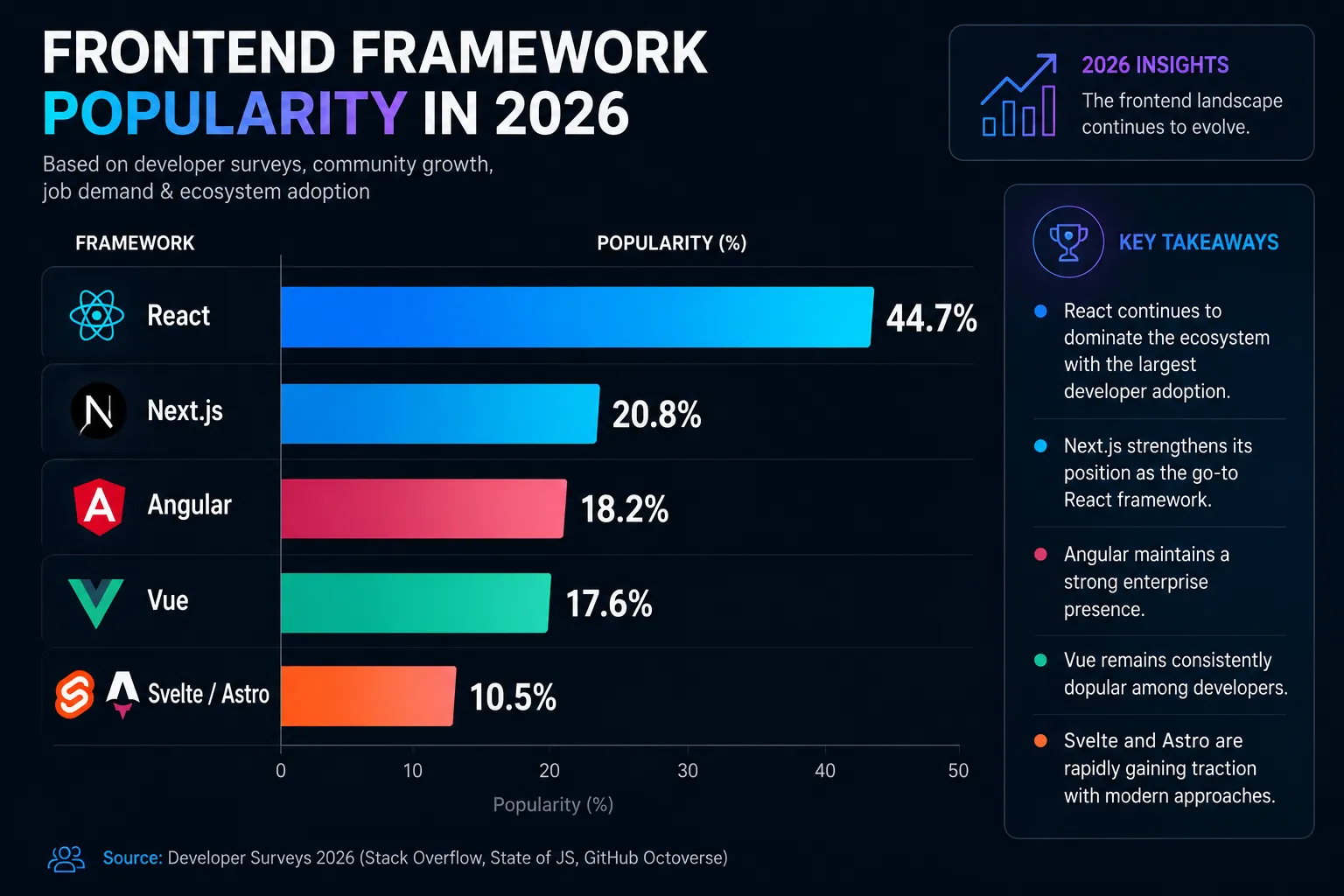
React remains the most widely used UI library in 2026, and by a meaningful margin. Its ecosystem is the deepest in the industry, with more packages, more tutorials, more tooling, and more job postings.
Recent data shows React leading at 44.7%, with Next.js at 20.8%, confirming that most teams building modern web interfaces still rely on the React ecosystem. Angular and Vue remain steady.
But the conversation has shifted. Nobody argues about whether React is useful. The question now is whether it's the right answer for every project — and increasingly, the answer is no.
Astro has become the preferred choice for content-heavy sites that prioritize performance. Its islands architecture ships zero JavaScript by default and hydrates components only where interactivity is actually needed.
SvelteKit has built a loyal developer base around its compiler-driven approach, which skips the virtual DOM entirely and produces small, fast output. Svelte 5 introduced "runes" for signal-based reactivity with native TypeScript support.
Qwik continues advancing its resumability concept, challenging how developers think about hydration at a fundamental architectural level.
3. Meta-Frameworks Are the New Standard
Going into 2026, the stack feels more mature and more opinionated than it did a year ago. For most frontend teams, 2026 no longer starts with the question "Which framework should we use?" The ecosystem has consolidated.
Meta-frameworks like Next.js, Astro, SvelteKit, Remix, and Qwik have become the default starting point for new projects. They simply take care of the work that used to slow projects down: routing, data fetching, server-side rendering, build optimisation, and deployment targets.
Performance may have sparked the early enthusiasm, but it isn't the only reason teams stick with these tools. Better performance brought developers in; better developer experience kept them there.
Next.js leads React projects with server components and strong edge tooling.
Astro appeals to teams building content-heavy sites with minimal JavaScript.
SvelteKit and Qwik attract developers who want smaller bundles and fast rendering.
Remix has settled into a stable position as a server-focused React framework.
4. The Three Frontend Shifts That Matter Most in 2026
According to frontend experts, React Server Components, signals-based fine-grained reactivity, and Interaction to Next Paint (INP) are the three frontend shifts that will most visibly separate well-architected products from struggling ones in 2026.
React Server Components (RSC): RSCs allow developers to keep heavy dependencies on the server, sending zero bundle size for those parts to the client. This results in incredibly fast initial page loads. React's compiler (formerly React Forget) is now standard, automatically optimizing re-renders without manual useMemo or useCallback hooks.
Signals-Based Reactivity: Frameworks like Angular (with signals), Svelte 5 (with runes), and SolidJS are adopting fine-grained reactivity for better performance.
INP-Focused Performance: Interaction to Next Paint has become the gold standard for measuring responsiveness. Frameworks must handle rendering without blocking the main thread.
5. The Server-First Mentality
When asked to describe the state of frontend development in a single word, one developer didn't hesitate: "Server-First."
The shift is clear: more work happens on the server, less JavaScript ships to the browser, requests are fewer, and bundles load faster. The result is a web that feels lighter, and a development process that depends more on strong defaults than manual optimisation.
Your backend becomes frontend-agnostic — the same APIs can power a web app, a mobile app, a partner integration, and an AI agent. Frontends are being generated faster and more cheaply than ever, while backends are becoming the strategic layer where business logic, governance, and trust live.
6. TypeScript: From Recommended to Required
TypeScript has shifted from "recommended" to essentially required. The JavaScript ecosystem has reached a tipping point: TypeScript is now the default, not an upgrade.
TypeScript catches mistakes early, makes refactoring less painful, supercharges your IDE's autocomplete, and gives new devs on your team built-in documentation. Types also give AI tools something to work with, which means fewer fixes after generation.
With strict TypeScript configurations, AI tools provide more accurate suggestions. Without it, suggestions drift toward guesses that pass the editor but fail at runtime.
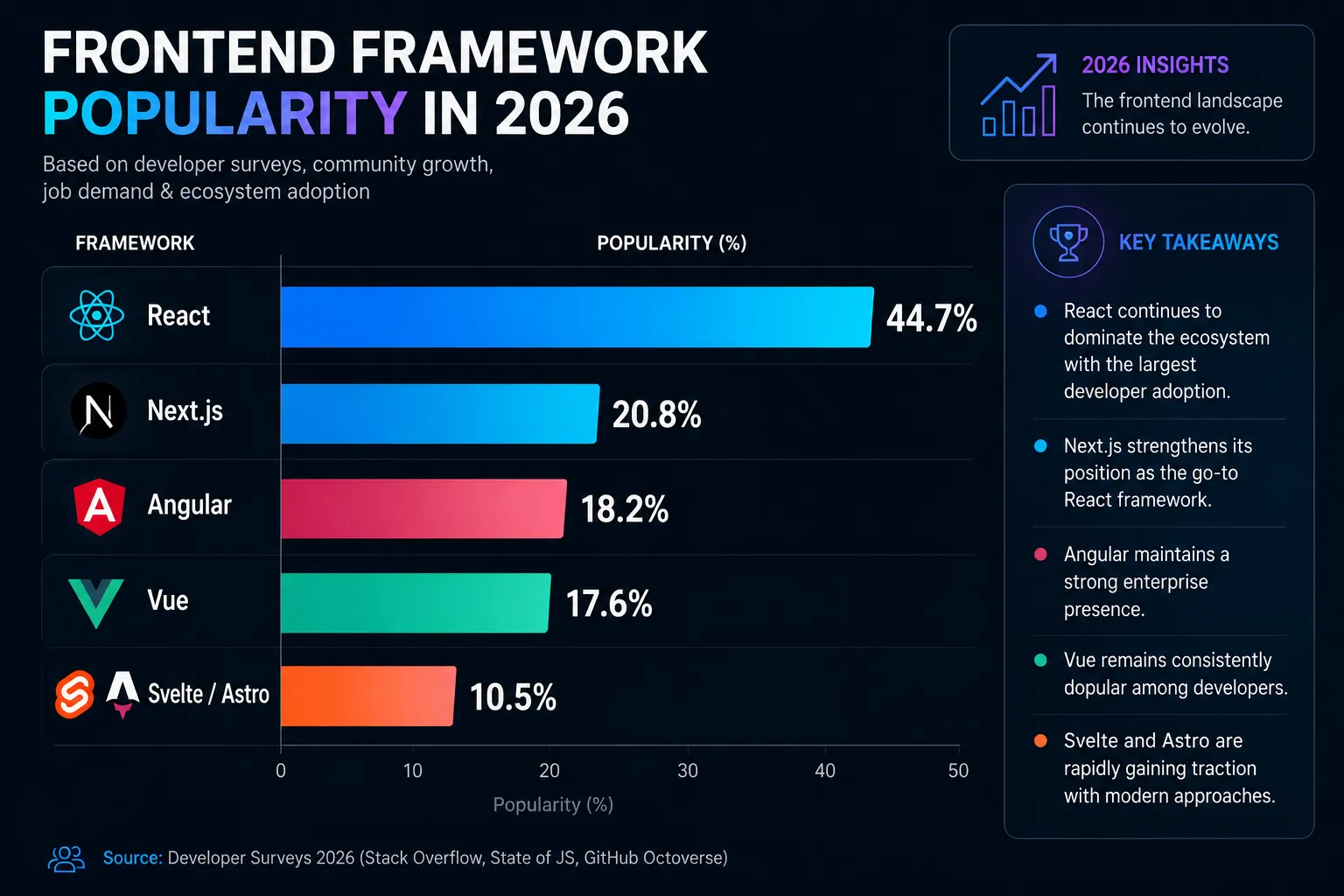
Image: React and Next.js dominate, but alternatives like Svelte and Astro are steadily gaining ground.
7. Performance Is a Competitive Advantage
In 2026, slow websites lose users immediately. Performance optimisation now includes edge computing, CDNs, image optimisation pipelines, lazy loading, and code splitting.
Speed impacts SEO, conversion rates, user retention, and brand credibility. Performance is now a core business metric — not just a technical concern.
Edge Computing: Moving logic closer to the user via edge functions is no longer optional for global apps. Global apps assume edge execution by default.
Core Web Vitals: Interaction to Next Paint (INP) is the gold standard. Frameworks must handle rendering without blocking the main thread.
8. Architecture Shifts: Jamstack, Headless, and Composable
Modern web development is shifting toward decoupled systems. Websites are no longer isolated platforms — they are content distribution hubs across devices.
Headless CMS: Platforms like WordPress now offer headless capabilities, allowing content to be delivered via APIs. Benefits include faster performance, omnichannel delivery, better scalability, and cleaner separation of concerns.
Jamstack: The modern web development stack — JavaScript, APIs, and Markup — continues to expand.
Composable Architecture: The question is no longer "which CMS should we use" but "which API should we connect," and from "which server" to "which edge network."
9. Web Security Is Built Into the Development Lifecycle
Cyber threats are more sophisticated than ever. Developers must now integrate security from day one.
Key security practices include HTTPS everywhere, secure authentication flows, multi-factor authentication, API rate limiting, and zero-trust architecture. Security is no longer just an IT department responsibility — it is embedded in DevOps workflows.
10. Progressive Web Apps (PWAs) Continue to Blur Lines
Web applications increasingly function like native mobile apps. PWAs now support offline access, push notifications, background sync, and app-like installation. This reduces reliance on app stores and simplifies user acquisition.
The 2026 Stack Recommendation
If you are starting a new project in 2026, here is a solid, battle-tested stack that works beautifully with AI tools:
- Language: TypeScript (non-negotiable)
- Framework: React with Next.js for RSC support, or TanStack Start for more control
- Styling: Tailwind CSS — utility-first CSS has won and works beautifully with AI tools
- UI Components: shadcn/ui — copy components directly into your project, own the code, and AI tools can read and edit these files directly
- State Management: TanStack Query for server state, Zustand for client state
- Hosting: Edge-first, serverless deployment
Final Thoughts
Web development in 2026 is far more than building websites — it is about engineering intelligent, scalable, secure, and inclusive digital experiences.
The most significant change is this: Websites are no longer static destinations. They are adaptive, data-driven ecosystems. AI is embedded in the workflow. Performance is a competitive advantage. The server is the default. TypeScript is required.
The tools are more powerful than ever. The challenge is knowing which ones are worth your attention. The key is matching the tool to the problem rather than defaulting to the same answer regardless of context.
The future of web development is already here. Are you building for it?
WebStudioLabs covers the latest in web development, AI, and technology trends. Bookmark us for more insights on where the industry is heading.
Check out our Professional Mobile App Development Service here