
ChatGPT Market Share Drops Below 50% for First Time — What's Happening?
For the first time since its launch in November 2022, ChatGPT no longer controls the majority of the AI assistant market.
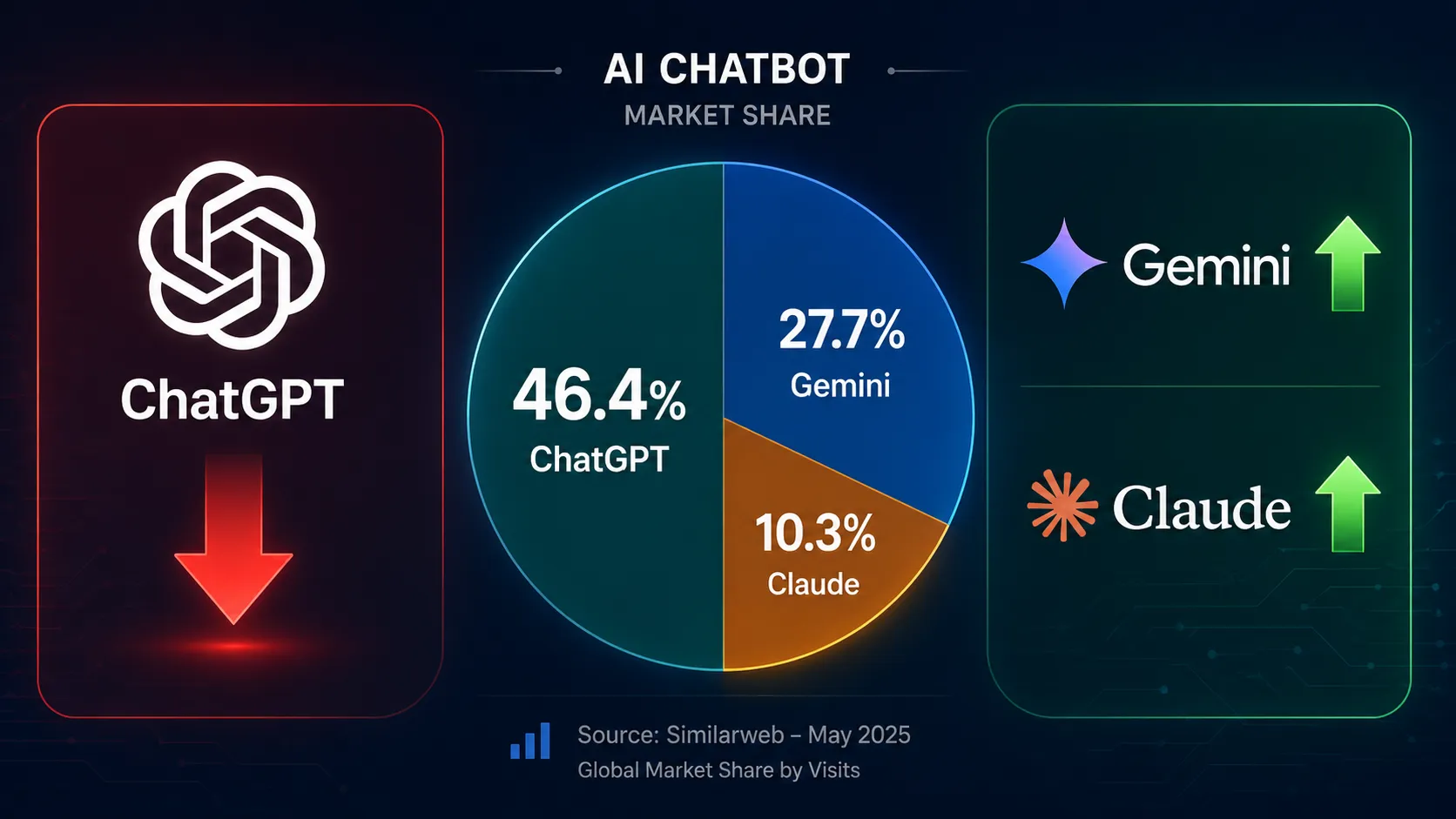
According to Sensor Tower's State of AI Report 2026, ChatGPT's global market share fell to 46.4% by the end of May 2026 — down from over 50% in January.
This is a historic moment. The AI assistant market is no longer a one-horse race. It is becoming a three-way rivalry between OpenAI, Google, and Anthropic.
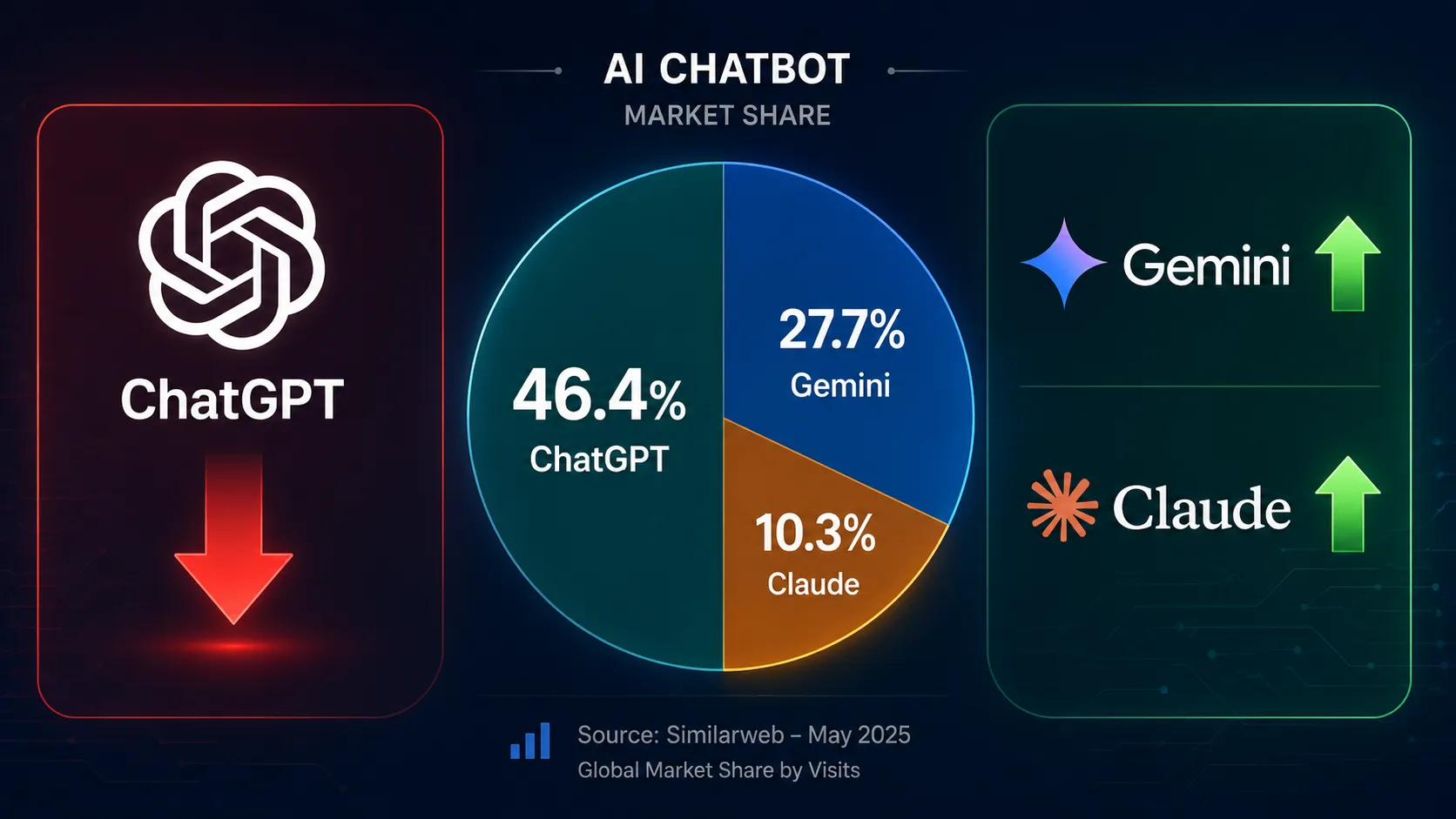
Image: ChatGPT's market share fell to 46.4% in May 2026 as competitors gained ground.
The Numbers: What Happened?
Let us break down the data from Sensor Tower's report.
- ChatGPT: 46.4% market share (down from 52.8% in December 2025)
- Google Gemini: 27.7% market share
- Anthropic Claude: 10.3% market share
- Others (Grok, Perplexity, DeepSeek, Meta AI): 15.6% combined
In simple terms: ChatGPT is still the largest player, but its dominance is shrinking. Gemini and Claude are growing fast.
User Numbers: Still Massive, But Gap Is Closing
Despite the market share decline, ChatGPT's user base is still enormous.
- ChatGPT: Over 1.1 billion monthly active users
- Gemini: 662 million monthly users
- Claude: 245 million monthly users
ChatGPT became the fastest app in history to reach 1 billion monthly active users — faster than TikTok, YouTube, Instagram, or WhatsApp.
But here is the catch: while ChatGPT's user base grew 62% over the past year, Claude's grew by a staggering 640%. The gap is closing — and fast.
Why Are Users Leaving ChatGPT?
Sensor Tower's report points to several reasons.
1. Users Are Switching Between Assistants
Previously, most people relied solely on ChatGPT. Now, users are increasingly willing to switch between AI assistants depending on the task.
Some use ChatGPT for general queries, Gemini for Google integration, and Claude for professional work. The "one AI for everything" era is ending.
2. Brand Trust Matters
In February 2026, OpenAI announced a partnership with the U.S. Department of Defense. The result? A measurable spike in app uninstalls.
Users care about who companies work with — not just product quality.
3. Competitors Are Offering Better Features
Gemini is growing largely due to its deep integration into Google's ecosystem — Gmail, Docs, Search, and Android.
Claude has built a strong reputation for productivity, coding, and research tasks. It is approaching ChatGPT in user retention.
The India Story: A Key Battleground
India has emerged as a crucial market for AI assistants.
- ChatGPT: 330 million monthly users in India (roughly one in three ChatGPT users worldwide)
- Gemini: 229 million users in India
- Claude: 72.3 million users in India (up from 13.3 million in December 2025)
The gap between ChatGPT and Gemini is much narrower in India than globally. Indian users are projected to spend 5.82 billion hours on generative AI apps in the first half of 2026 — up from 1.66 billion hours in the same period last year.
Who's Making Money?
Market share is one thing. Revenue is another.
Claude leads in monetization. Thirteen percent of Anthropic's users are paying for a subscription — the highest conversion rate in the industry.
For comparison, ChatGPT's iOS subscription conversion rate is 8%.
In the first half of 2026, users downloaded nearly 2.3 billion AI apps and spent over $4.2 billion on them — up from $1.83 billion in the same period of 2025.
The market is shifting from pure growth toward monetization.
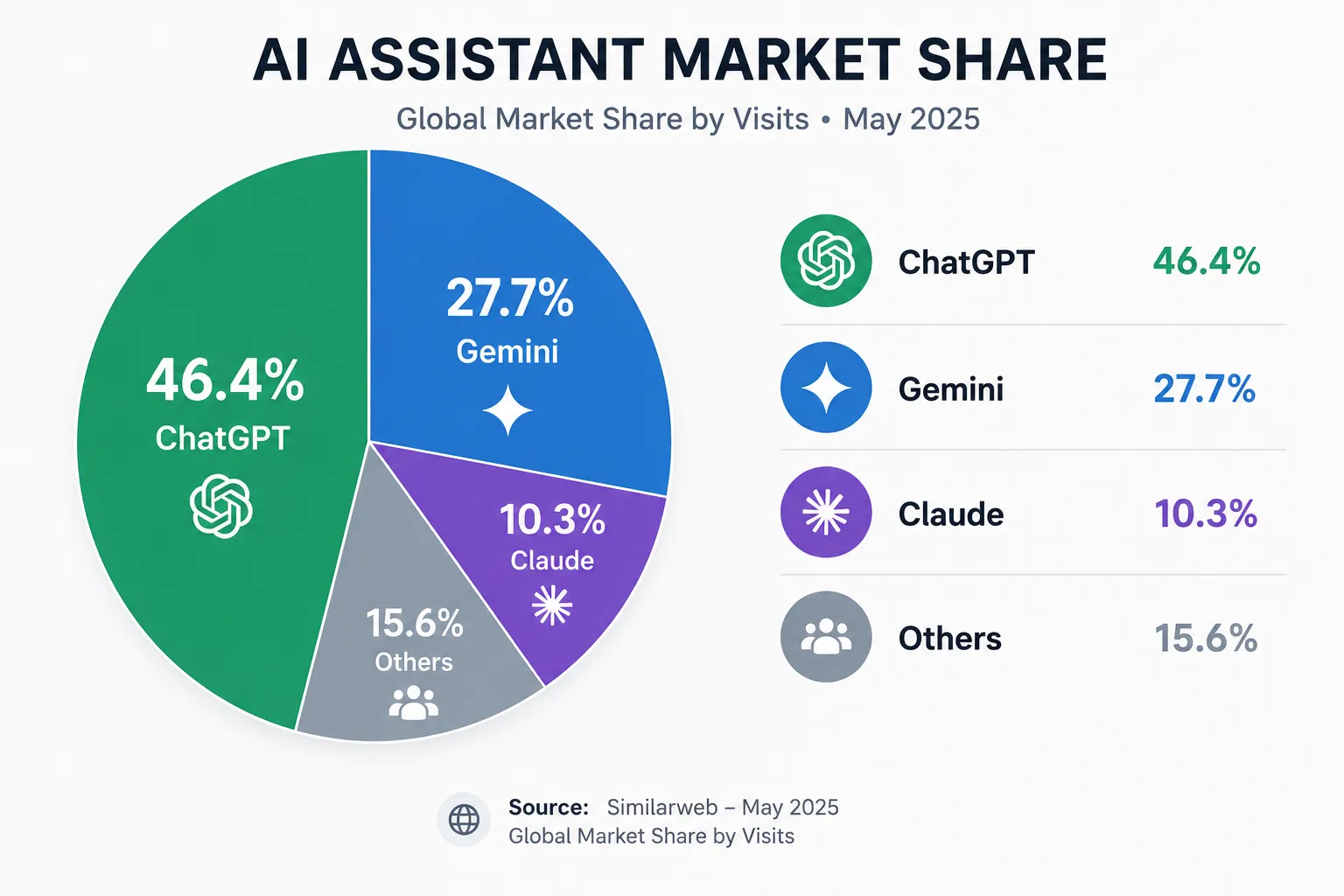
Image: The AI assistant market is now a three-way race between ChatGPT, Gemini, and Claude.
ChatGPT, Gemini, and Claude Control 89% of User Time
Despite the fragmentation, three players dominate user engagement. ChatGPT, Gemini, and Claude together control 89% of the time users spend in AI assistant apps.
The remaining players — Grok, Perplexity, DeepSeek, and Meta AI — each hold less than 5% market share.
What This Means for the AI Market
The monopoly is over. For three years, ChatGPT was the default AI assistant. That era is ending. Users now have choices — and they are exercising them.
Integration is the new battleground. Gemini's Google ecosystem integration is its biggest advantage. Claude's productivity focus is its strength. ChatGPT's first-mover advantage is fading.
Monetization matters. User growth is slowing. The next phase of competition will be about revenue per user, not just total users.
The market is maturing. The explosive growth phase is over. The AI assistant market is entering a more mature, sustainable phase.
Final Thoughts
ChatGPT losing its majority market share is not the end of OpenAI. It is the beginning of a new chapter for the entire AI industry.
The AI assistant market is becoming more competitive, more diverse, and more sophisticated. Users are smarter. They are voting with their feet. They are choosing the right tool for the right job.
For OpenAI, the challenge is clear: innovate faster, rebuild trust, and prove that ChatGPT is not just the first — but the best.
For users, the message is equally clear: you now have real choices. And that is a good thing.
The AI wars have only just begun.
WebStudioLabs covers the latest in AI, tech trends, and market analysis. Bookmark us for more updates on the rapidly evolving AI landscape.
Check out Custom Web Application Development Service here