
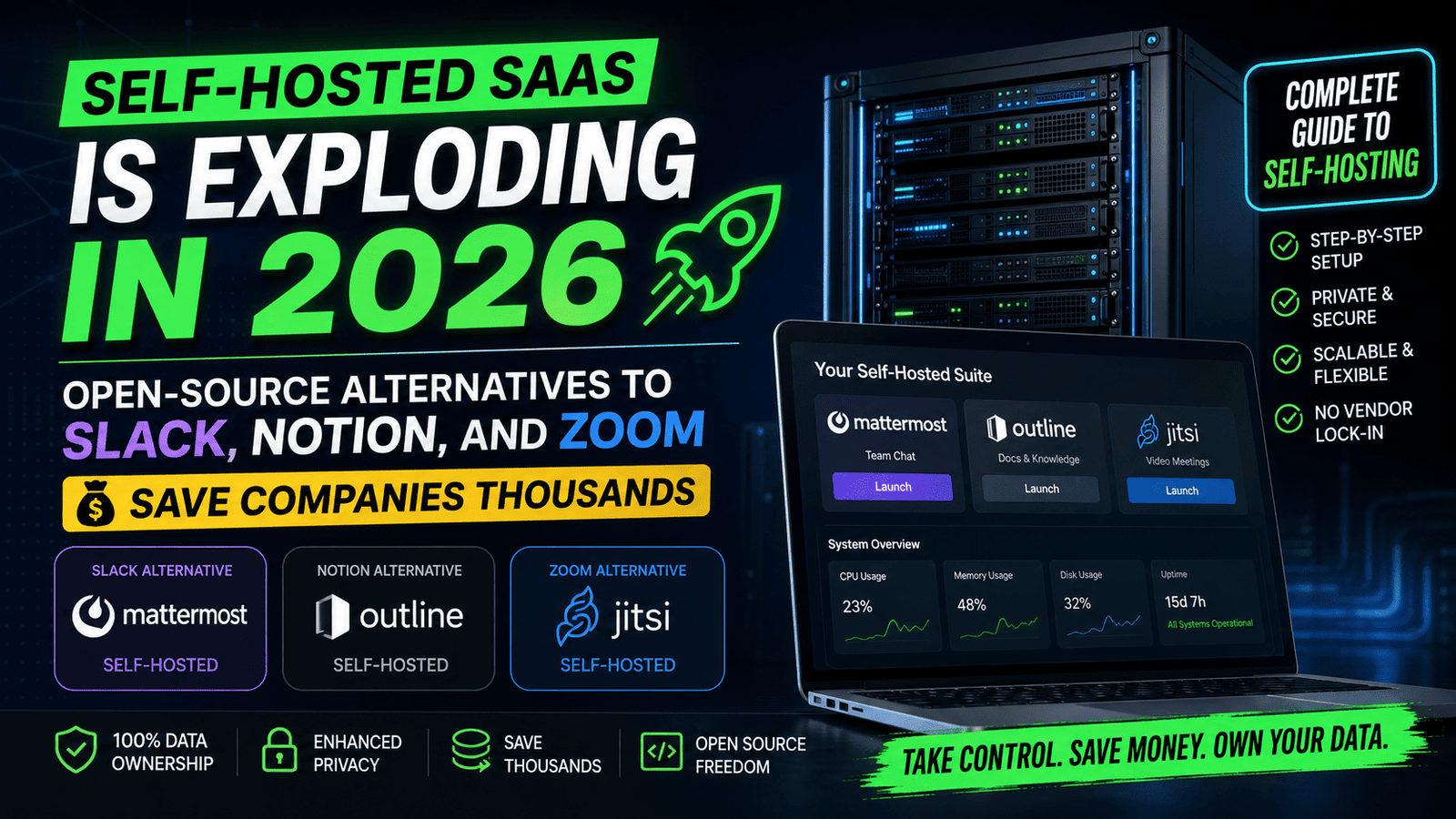
Self-Hosted SaaS Is the New Trend — Save 90% on Software Costs
Here is something interesting. A small startup in Bangalore was paying $15,000 per year for software subscriptions. Slack. Notion. Zoom. Google Workspace. Jira. The list went on.
Then they discovered self-hosted SaaS. They replaced Slack with Mattermost. Notion with AppFlowy. Zoom with Jitsi. And their software costs dropped by 90%.
This is not an isolated story. Self-hosted SaaS is exploding in 2026. And it is changing how companies think about software.
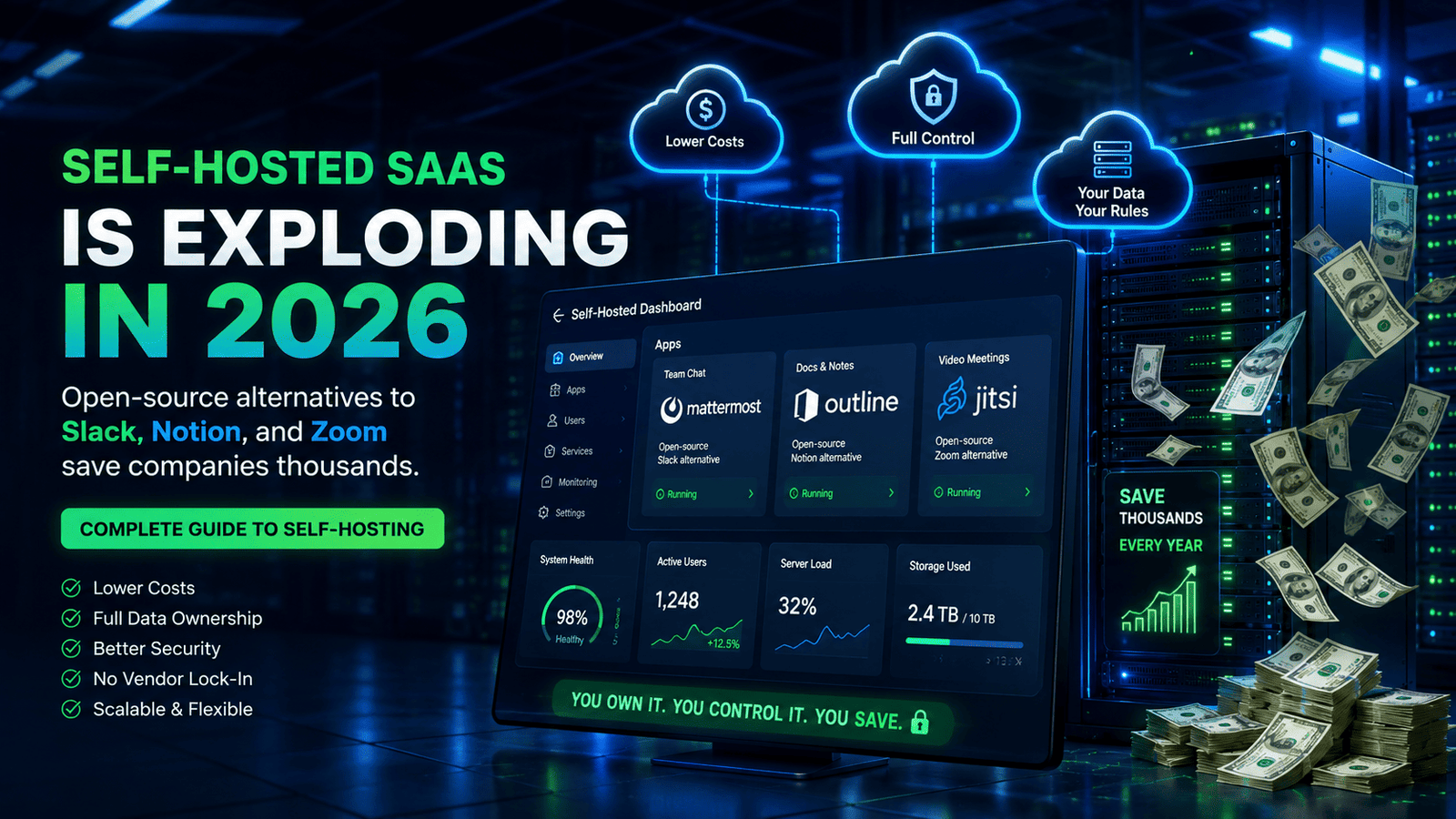
Image: Self-hosted SaaS lets companies run business software on their own servers.
What Is Self-Hosted SaaS?
Normally, SaaS (Software as a Service) means you pay a monthly fee to use someone else's software. Slack charges per user. Notion charges per user. Zoom charges per host. The costs add up fast.
Self-hosted SaaS flips this model. You run the software on your own servers. You control everything. You pay nothing to the software vendor. Your only cost is server infrastructure.
Most self-hosted software is open-source. The code is free. You can inspect it. Modify it. Extend it. You are not locked into anyone's pricing model.
And in 2026, the quality of self-hosted software is as good as — sometimes better than — paid alternatives.
Why Self-Hosting Is Blowing Up in 2026
Three reasons. Money. Control. Privacy.
Money
SaaS costs have spiraled out of control. A 50-person company can easily spend $50,000+ per year on software. And prices keep rising. Self-hosting cuts that to near zero.
Control
With SaaS, the vendor controls your data. They can change their terms. They can raise prices. They can even shut down. With self-hosting, you own everything.
Privacy
Data privacy laws are tightening. GDPR. CCPA. India's Digital Personal Data Protection Act. Many companies cannot legally use cloud services for sensitive data. Self-hosting solves that.
The 2026 Self-Hosted Stack
Here is the stack that companies are switching to in 2026.
Communication — Mattermost (Slack Alternative)
Mattermost is an open-source Slack alternative. It has everything Slack has — channels, direct messages, file sharing, integrations. But it runs on your own servers. Zero per-user fees.
Knowledge Management — AppFlowy (Notion Alternative)
AppFlowy is the open-source Notion alternative. It has databases, pages, markdown, and collaborative editing. It runs locally or on your servers. Free. Forever.
Video Conferencing — Jitsi (Zoom Alternative)
Jitsi is the open-source Zoom killer. It handles HD video conferencing for unlimited participants. Runs on your own servers. No per-host fees. No time limits.
Project Management — Plane (Jira Alternative)
Plane is the open-source Jira alternative. It has issue tracking, sprints, roadmaps, and custom workflows. Self-hosted. Free. Flexible.
File Storage — Nextcloud (Google Drive/SharePoint Alternative)
Nextcloud is the open-source file sharing platform. Sync files across devices. Collaborate on documents. Manage file permissions. All on your own servers.
What About the Cloud Giants?
Google. Microsoft. Amazon. They are not going anywhere. But they are noticing the shift.
More companies are asking: Why pay $10/user/month for Slack when Mattermost is free? Why pay $8/user/month for Zoom when Jitsi is free? Why pay $10/user/month for Notion when AppFlowy is free?
The cloud giants are responding. They are making their own open-source moves. Amazon now offers open-source versions of some services. Microsoft supports the open-source ecosystem more than ever. Google is open-sourcing certain AI models.
But for many companies, the shift to self-hosted SaaS is already happening. And it is saving them thousands of dollars per year.
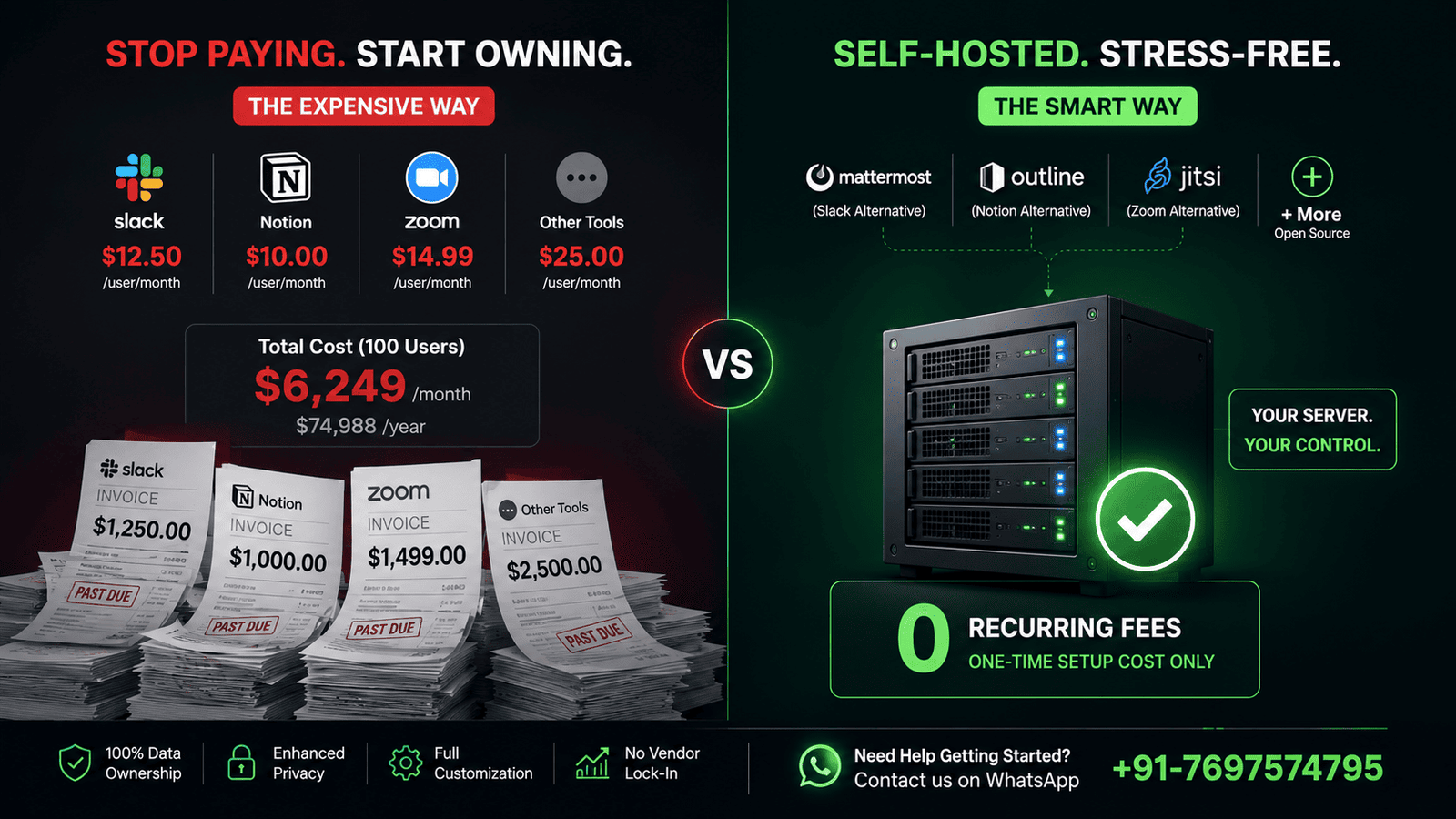
Image: Self-hosting cuts software costs from thousands to near zero.
The Secret Advantage: Data Portability
There is another benefit that few people talk about — data portability.
With SaaS, you are locked in. If you want to leave Slack, you lose your message history. If you leave Notion, you lose your databases. If you leave Zoom, you lose your recordings.
With self-hosted software, you own your data. You can export it anytime. You can migrate to another system. You are not at the mercy of a vendor.
This is becoming a major consideration for companies. Especially as SaaS prices continue to rise.
Is Self-Hosting Hard?
This used to be the biggest objection. Self-hosting required servers, Docker, Kubernetes, and a SysAdmin. It was hard.
In 2026, it is much easier.
Most self-hosted software comes with one-click deploy options. You can run it on a $6/month VPS from DigitalOcean. You can deploy it on AWS with a single CloudFormation template. You can even run it on an old laptop in your office.
There are platforms that make it even easier. Deploy a complete self-hosted stack with one click. No Docker expertise needed.
If you can set up a WordPress site, you can set up self-hosted software.
The Future of Self-Hosted SaaS
This trend is accelerating. Here is what experts predict.
By 2027, self-hosted SaaS will be the default for most medium-sized companies. Large enterprises will move many systems in-house. Even small businesses will use self-hosted solutions.
AI tools will be self-hosted too. Companies will run their own LLMs on their own servers. They will not send sensitive data to OpenAI or Google.
Data privacy regulations will make self-hosting mandatory for many industries. Healthcare. Finance. Government. Legal.
The SaaS vendors know this. Many are offering self-hosted versions of their own software. But at a premium price. The open-source alternatives offer the same functionality for free.
Should You Make the Switch?
Here is my honest take.
Switch to self-hosting if:
- You have a small team and want to save money
- You have a technical team that can manage servers
- You care about data privacy and control
- You are tired of SaaS price hikes
Stay with SaaS if:
- You have zero technical resources
- You need niche integrations that only SaaS supports
- You are a solo creator with simple needs
For most companies, a hybrid approach works best. Self-host the core tools. Use SaaS for specialized needs.
Final Thoughts
Five years ago, self-hosting was for nerds. It was complicated. It was niche. It was not for normal businesses.
In 2026, self-hosting is mainstream. The tools are mature. The deployment is simple. The cost savings are massive.
Companies that adopt self-hosting will save thousands of dollars every year. They will control their own data. They will not be at the mercy of SaaS vendors.
The shift is happening. The only question is: Will you be part of it?
Self-host. Save money. Take control.
WebStudioLabs covers the latest in open-source tools and cost-saving technologies. Bookmark us for more guides on self-hosting and automation.
Check out our Professional Portfolio Website Design Development Service here