
Software Engineering in 2026: AI Agents, Rust's Rise, and the Code Revolution
Software engineering in 2026 is undergoing its most dramatic transformation since the invention of the programming language itself. AI agents now resolve nearly 90% of real-world software engineering tasks — up from under 5% just three years ago. Rust has cracked the top 10 programming languages for the first time. And AI-generated code is now running in production at 44.7% of organizations worldwide.
This is not a gradual evolution. This is a structural shift. Here is everything you need to know about the state of software engineering in 2026.
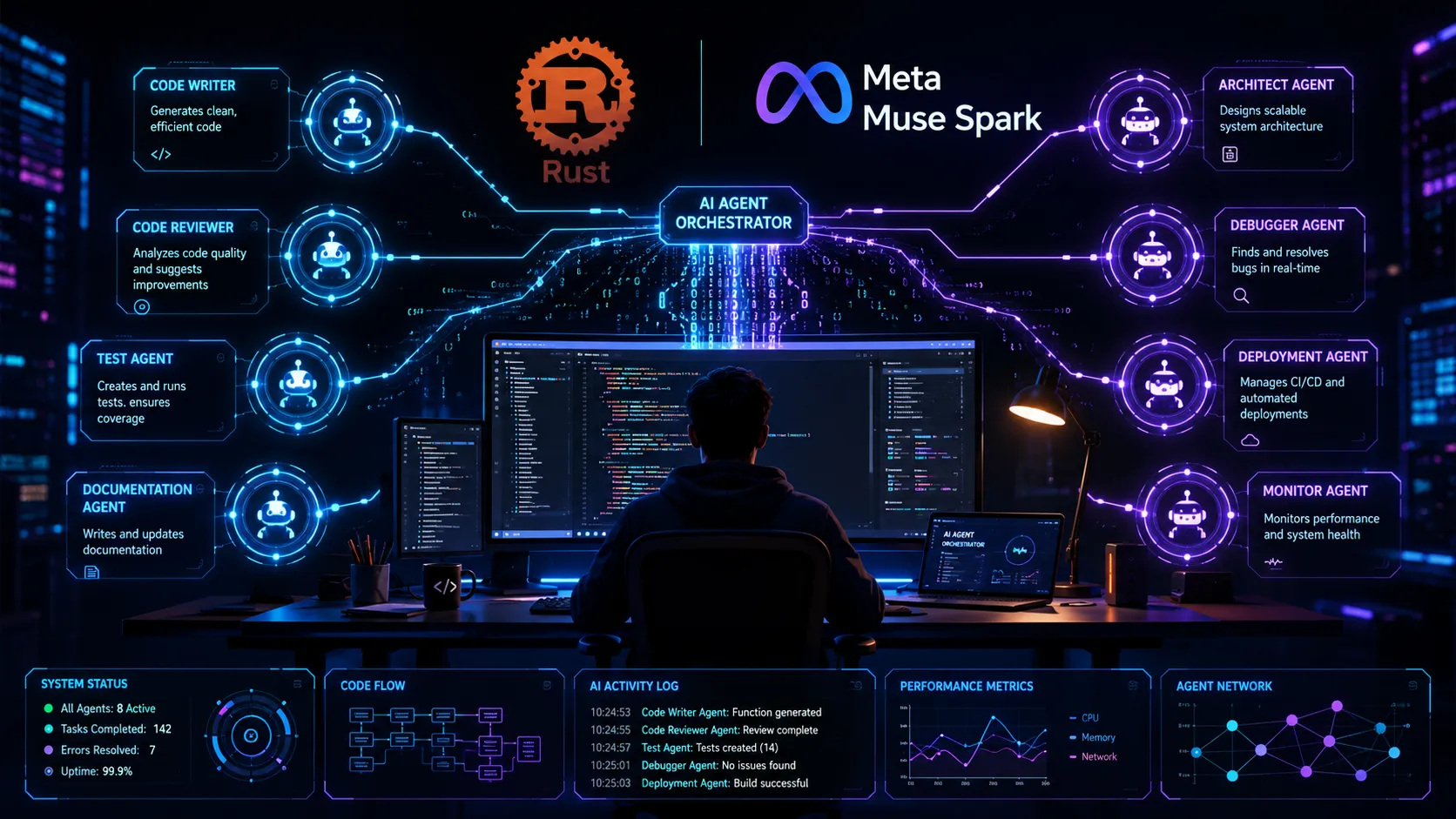
Image: AI agents are becoming active participants in the software development lifecycle.
1. AI Agents Can Now Resolve 90% of Software Engineering Tasks
This is the single most important number in software right now. Autonomous AI agents can now resolve nearly 90% of real-world software engineering tasks — up from under 5% three years ago. What used to require human intervention for almost everything now runs largely on autopilot.
This shift is documented in real-world practice: from AI-assisted code completion, through fully autonomous agent loops, to multi-agent orchestration where a single engineer directs parallel workstreams without writing a line of code. Three fundamental changes follow from this: tests and formal specifications have become the primary human artifact; technical debt now accumulates at machine speed; and the roles of junior, mid, and senior engineers are being rearranged.
Nvidia CEO Jensen Huang put it bluntly: "Every one of my software engineers prefers to be building agents than to be writing Python code." He explained that AI is reducing the amount of manual coding engineers perform, allowing them to focus on designing AI systems, creating benchmarks, and developing guardrails. "You're taking all the mundane work, and you're trying to get this agent to do it. That requires imagination, that requires creativity, a lot of technology."
2. The Orchestration Layer Is the New Battleground
Barely a year after prompt engineering emerged as one of AI's hottest skills, the industry is already looking beyond it. Hiring for standalone prompt engineering roles has plateaued as companies increasingly seek engineers who can build and orchestrate agentic or autonomous AI systems.
According to staffing firm TeamLease Digital, hiring requirements asking for AI agents, agentic AI, autonomous workflows, and AI orchestration have grown by almost 180% to 220% over the last 12 months. Agentic AI developer roles have grown 260% year on year, while AI software engineer roles focused on agentic systems and Model Context Protocol (MCP) have increased 225%.
Today, employers are looking for engineers who can build production-grade AI systems with skills such as multi-agent systems, AI orchestration frameworks, AI evaluation, observability, and autonomous workflow design. Prompt engineering is becoming a foundational skill rather than a standalone role. What employers are actively competing for now are skills that sit at the deployment and orchestration layer, including MCP, multi-agent orchestration frameworks, retrieval-augmented generation, LLMOps, and MLOps.
3. AI-Generated Code Is in Production at 44.7% of Organizations
This is the data point that separates the hype from reality. According to a Dimensional Research study of 309 engineering leaders across five continents, 44.7% of organizations already run AI-generated code in production. Another 35% use AI to write code but do not release it into production because they lack enough visibility into what it changes.
The results suggest AI-assisted coding has moved beyond trial use in many engineering teams, but oversight processes have not kept pace. The main constraint has shifted from generating code to reviewing, understanding, and trusting it before release.
Teams are most likely to use AI for lower-risk, repetitive tasks. Documentation was the most common use case at 68.7%, followed by unit testing at 65.9%. Simple functions and code review each stood at 57.7%. That pattern suggests organizations are applying the tools cautiously — engineering groups appear more willing to rely on AI output when tasks are predictable and easier to verify.
4. The Governance Problem: Security Risks Are 2x Higher
Here is the catch. AI-generated code carries roughly double the security risk violations of human-written code, according to testing by the Software Improvement Group. The same report found that 80.5% of organizations have changed development and release processes to account for AI-generated code. Even so, respondents said the hardest issues to catch from week to week were security problems at 49.2%, dependency changes at 47.7%, and performance impacts at 44.1%. Only 3.6% said issues introduced by AI never reach production — meaning most teams still expect some errors or unintended consequences to pass through existing checks.
Concern extends beyond engineering teams. Respondents reported unease among security teams in 62.5% of organizations, compliance teams in 51.5%, Chief Technology Officers and Chief Information Officers in 46.9%, and legal teams in 40.8%.
Flux CEO Ted Julian captured the core issue: "Engineering leaders are being asked to embrace AI while simultaneously justifying the expense and mitigating the risk, typically with the same tools they used before AI wrote any code. You can't bolt AI-speed development onto a human-speed view of the codebase and stay in control."
5. Rust Cracks the Top 10 for the First Time
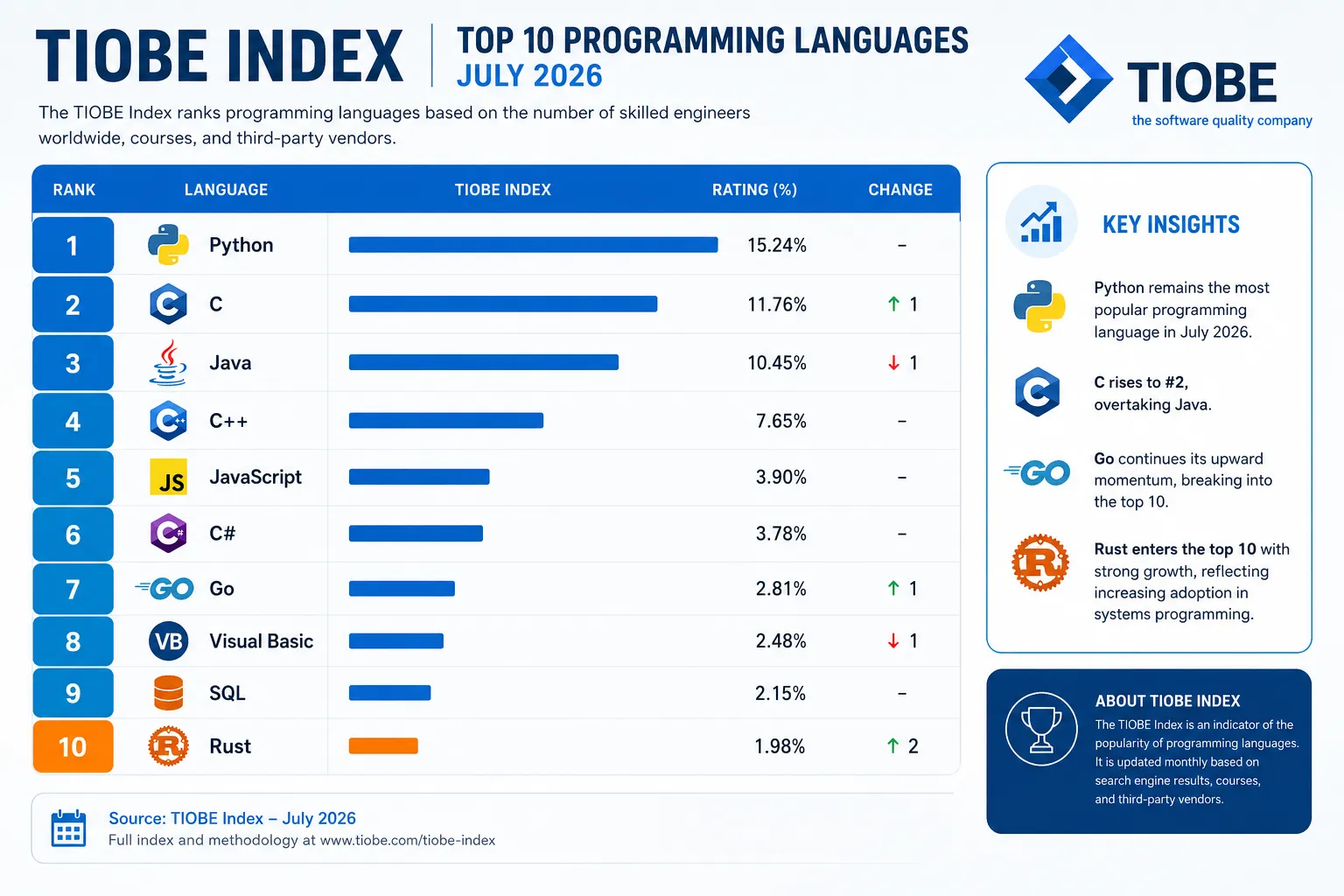
For the first time ever, Rust has broken into the top 10 in the TIOBE index of programming language popularity. With a 1.34% rating, Rust is now ranked 10th in the TIOBE Programming Community Index for July 2026, up from 18th place in July 2025.
TIOBE CEO Paul Jansen explained: "Rust's growing popularity can largely be attributed to its strong focus on memory safety while still generating extremely fast code. Rust is widely regarded as a direct competitor to C and C++, both of which continue to struggle with the challenges of explicit memory management and are therefore often considered less safe."
The alternative PYPL index for July 2026 shows Python dominating at 47.49%, followed by Java at 11.44%, C/C++ at 9.68%, and Rust at 2.06% — tying with C#. Rust and Mojo are the two languages signaling where the field is heading in 2026: Rust for memory-safe AI infrastructure, Mojo for Python-compatible code that compiles to native machine speed.
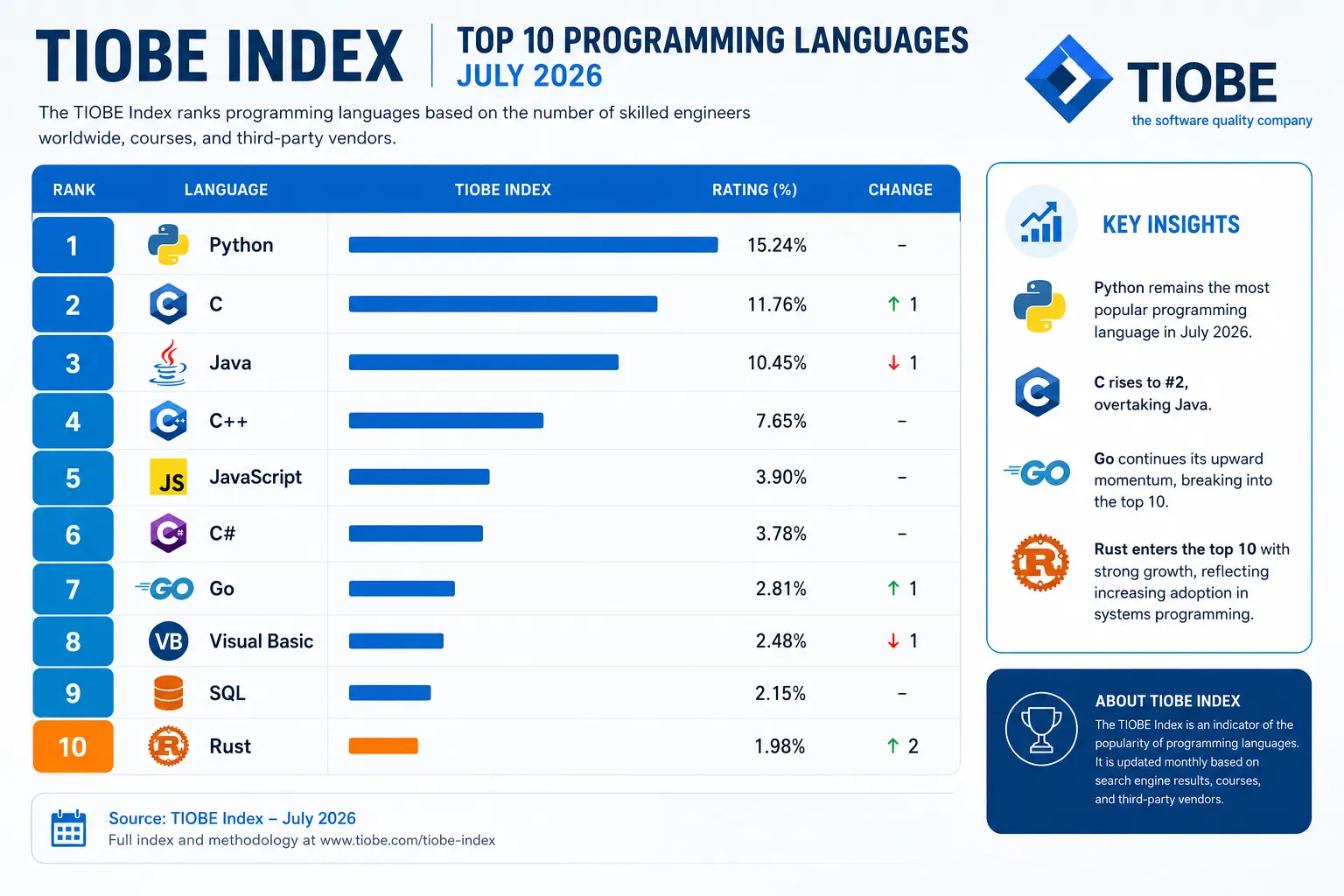
Image: Rust has cracked the top 10 programming languages for the first time in history.
6. Meta Enters the AI Coding Battle with Muse Spark 1.1
The next front in the AI race isn't another chatbot. It's code. For months, companies such as OpenAI, Anthropic, and Google have been racing to build AI systems that write software, fix bugs, migrate codebases, and carry out tasks that once belonged to teams of engineers. Now Meta wants a place in that conversation.
The company has unveiled Muse Spark 1.1, an upgraded version of its coding-focused AI model designed for complex software development and agentic workloads. Meta is also opening a public preview of its new Model API, giving US developers direct access to the model.
According to Meta, the model is built to tackle large software projects instead of isolated snippets of code. It can debug applications, assist with code migration, understand images, video, and documents alongside text, and carry out multi-step tasks with limited human assistance. These capabilities place it squarely in the growing market for agentic AI — systems designed to complete entire workflows rather than respond to prompts one at a time.
7. Platform Engineering Goes AI-Native
As AI coding assistants become increasingly common, organizations are reporting faster code generation and higher delivery throughput requirements. This is creating new demands on platform teams.
Platform Engineering 2.0 extends everything the community built in 1.0 and closes the structural gaps that the new era has exposed. AI-native development platforms are now a priority for CIOs. The agentic future means applications are embedding autonomous AI agents — and platforms are next.
8. Teams Are Getting Smaller, Not Bigger
Gartner predicts that 60% of organizations will deploy smaller software engineering teams at scale by 2029, a sharp increase from 15% in 2026. The trend is clear: smaller, multidisciplinary teams that leverage AI to deliver more complex work without reducing engineering talent.
This shift is already visible in hiring data. 49.1% of active AI hiring demand is concentrated in professionals with three to five years of experience, suggesting companies are looking for engineers who can immediately build and deploy AI systems rather than entry-level talent that needs extensive training.
What This Means for Software Engineers in 2026
Let me summarize what these trends mean for you:
Your role is evolving. You are moving from code writer to AI orchestrator. The people who thrive will be those who learn to manage AI agents, not just compete with them. Senior developers increasingly describe their day-to-day not as writing code, but as describing what they want built, reviewing what an AI system produced, and deciding whether to accept, redirect, or escalate.
Your skills need to expand. AI literacy, architectural thinking, and ethical technology design are becoming as important as programming basics. The fastest-growing jobs today revolve around building AI agents, deploying enterprise AI systems, and integrating large language models into everyday business workflows.
Rust is worth learning. If you are a systems programmer, embedded developer, or AI infrastructure engineer, Rust is becoming non-negotiable.
Security is everyone's job. With AI-generated code in production, security can no longer be an afterthought. Embed it early. Embed it everywhere.
Final Thoughts
Software engineering in 2026 has transformed from a craft into an orchestration discipline. AI agents can now resolve 90% of tasks. Rust is in the top 10. AI-generated code is in production everywhere. And the role of the software engineer has shifted from writing code to orchestrating the systems that write it.
As one developer put it, the unit of work is shifting from "lines of code" to "outcomes delegated." This is a genuine change in the nature of software engineering work. Engineering leaders who haven't adjusted how they evaluate productivity, code review practices, and onboarding for this reality are already behind.
The tools are changing. The workflows are changing. The skills are changing. The only constant is change itself — and in 2026, that change is accelerating faster than ever.
The future of software engineering is already here. Are you ready for it?
WebStudioLabs covers the latest in software engineering, AI, and technology trends. Bookmark us for more insights on where the industry is heading.
Check out our Professional Website Development Services here