
AI-Native Development in 2026: Cursor, Windsurf & The Agentic IDE Revolution
If you are still thinking of AI coding as "ChatGPT writing snippets" or "Copilot autocomplete," you are already behind.
The era of passive AI assistants is over. 2026 is the year of AI-native development — where AI agents don't just suggest code, they understand entire codebases, orchestrate multi-file changes, and work autonomously alongside developers.
Two tools are leading this revolution: Cursor and Windsurf (by Codeium). And on the framework side, Vercel AI SDK 4 has become the standard for integrating AI into web applications.
Here is everything you need to know about AI-native development in 2026.
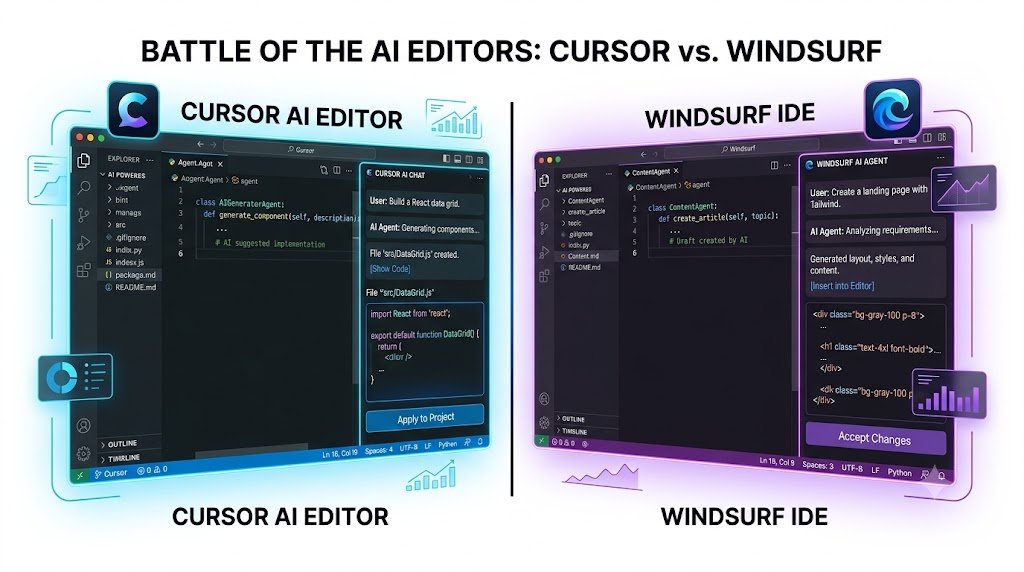
Image: Cursor and Windsurf are the two leading AI-native code editors redefining software development in 2026.
What Is AI-Native Development?
AI-native development is not about adding an AI plugin to an existing editor. It is about rebuilding the entire development environment around AI.
Traditional tools like VS Code with Copilot treated AI as an add-on — a "smart autocomplete" grafted onto a text editor. The AI only had access to the file currently open on the screen. It could not see the full project, understand dependencies, or reason about architecture.
AI-native IDEs are different. They are built from the ground up with AI at the core. They index entire codebases, maintain vector databases of project context, and use advanced retrieval-augmented generation (RAG) to pull in relevant information from distant files.
As one industry report put it: "The 'plugin' era is over; the 'platform' era is here."
The Two Giants: Cursor and Windsurf
In 2026, two AI-native IDEs dominate the conversation: Cursor (developed by Anysphere) and Windsurf (developed by Codeium). Together, they have effectively replaced the passive assistant with an active agent.
Cursor: The Speed and Context Champion
Cursor is an AI-first code editor built as a fork of Visual Studio Code. It layers deep AI capabilities on top of the familiar VS Code environment.
Key Features:
- Full Codebase Awareness: Cursor indexes your entire project and keeps that understanding current as you work. It can answer questions about any part of the codebase.
- Composer Mode: For complex tasks, Cursor can research the codebase, ask clarifying questions, create a plan, and execute against that plan.
- Agentic Coding: Cursor can plan, write, review, and execute coding tasks — not just suggest snippets.
- Background Cloud Agents: Cursor provides background agents that can plan changes, apply diffs, run and test code, and iterate asynchronously in an isolated remote environment.
- Multi-File Editing: Make changes across multiple files from a single instruction.
Who It's For: Cursor is built for software engineers who live in a code editor. It assumes you know what a repository is, how to run a local server, how to deploy code, and how to debug. The AI makes that work faster — it does not remove it.
Adoption: Cursor hit 2 million users and achieved $2 billion in annual recurring revenue by early 2026.
Windsurf (by Codeium): The Agentic Orchestrator
Windsurf is Codeium's answer to Cursor. While Codeium originally made its name with a free-tier autocomplete tool, Windsurf is their full-IDE-and-agent solution.
Key Features:
- Cascade AI Agent: Windsurf's autonomous AI agent can plan multi-step code changes, execute terminal commands, read linter output, and modify files across entire projects.
- Agentic Multi-Step Flows: Windsurf emphasizes agentic coding flows where the AI plans and executes sequences of changes across files.
- Fast Context: Windsurf uses proprietary SWE-grep models that "browse" the codebase 20 times faster than traditional RAG, understanding the "why" behind code structure by tracing dependencies in real-time.
- MCP Integration: Windsurf connects directly to live databases, Jira boards, and Slack channels through the Model Context Protocol.
- 70+ Languages, 40+ IDEs: Codeium supports over 70 programming languages and integrates with more than 40 IDEs.
Who It's For: Windsurf is built for developers who want AI to handle complex, multi-step workflows. It is particularly strong for engineers working on large production codebases who need AI to orchestrate changes across multiple files and systems.
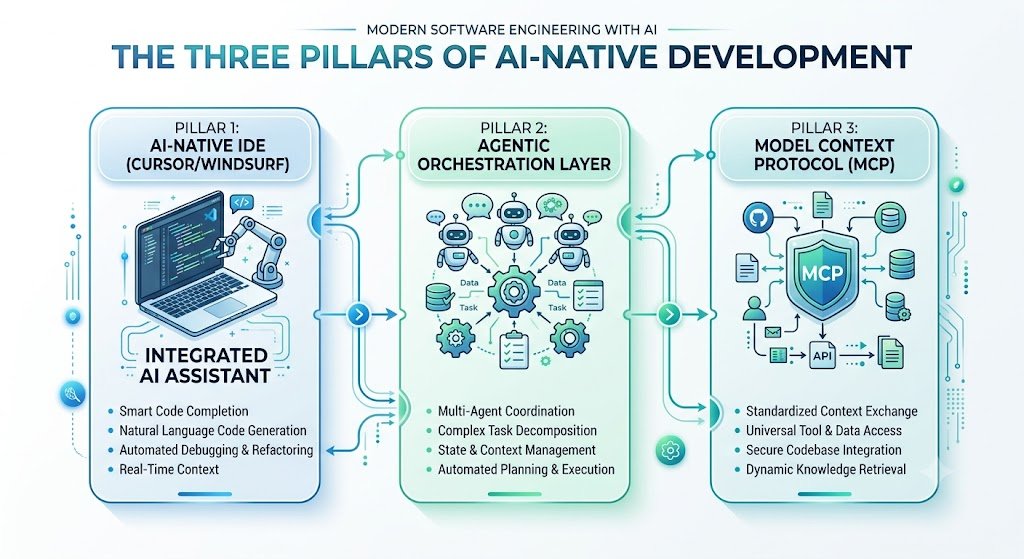
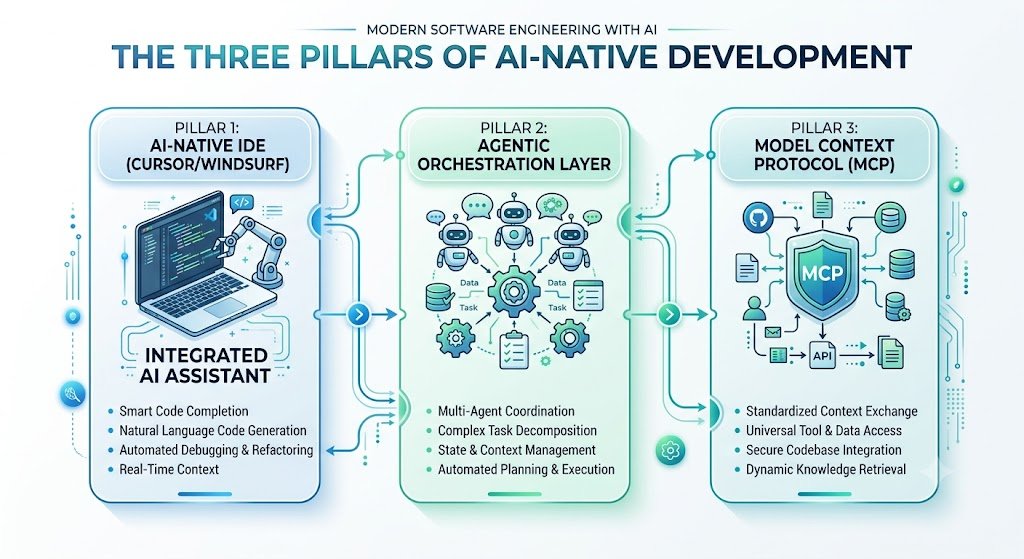
Image: The modern AI development stack rests on three pillars: the AI-Native IDE, the Agentic Orchestration Layer, and connectivity standards like MCP.
Cursor vs Windsurf: The 2026 Comparison
Both tools are genuinely capable. Both are purpose-built for developers who live inside a codebase. But they have different strengths.
| Factor | Cursor | Windsurf (Codeium) |
|---|---|---|
| Best For | Deep codebase understanding, fast prototyping, frontend work | Agentic multi-step flows, complex orchestration, enterprise |
| Core Innovation | Shadow Workspace, Composer mode, Tab-to-Edit | Cascade AI Agent, Fast Context, MCP integration |
| Codebase Awareness | Hybrid indexing with local vector database | SWE-grep models, 20x faster than RAG |
| Pricing | $20/month (Pro), Free tier available | Free for individuals, Enterprise plans available |
| User Base | 2M+ users, $2B ARR by early 2026 | Growing rapidly, strong enterprise adoption |
| Enterprise Governance | Limited compared to enterprise tools | Strong enterprise features, SOC2-ready |
The Data: How AI-Native Development Is Changing Everything
Cursor's Spring 2026 Developer Habits Report provides a data-driven look at how AI-native development is transforming software engineering.
Developers Are Adding More Code: Lines added per developer per week have grown from 3.6K in early 2025 to 8.6K by mid-2026 — a 2.4x increase.
PRs Are Getting Larger: Lines added per pull request are up roughly 2.5x year over year, and the growth rate is accelerating.
AI Code Survives Longer: Since early 2026, the percentage of AI-suggested code that remains in the codebase 60 minutes after being accepted has increased from approximately 76% to 81%.
Agent Sessions Are Going Deeper: Coding agents are taking on more complex work — reading and editing files, searching code, running shell commands, and browsing the web more frequently.
AI SDKs: The Standard for Web Development
AI-native development is not just about editors. It is also about how AI is integrated into web applications.
In 2026, Vercel AI SDK 4 (ai@4) has become the default for any React + Next.js app.
What It Does: The AI SDK is an open-source TypeScript library that simplifies integrating LLMs like OpenAI, Anthropic, and Google Gemini into web applications.
Why It Matters:
- Provider-Agnostic: Switch providers by changing a single string instead of rewriting code.
- Streaming Support: Built-in streaming responses for real-time chat experiences.
- React Hooks: useChat, useCompletion, useObject, useAssistant — all built-in.
- Tool Calls: Unified, type-safe tool calling across providers.
- Structured Output: Generate structured objects with Zod schemas.
As one developer put it: "The 2026 default for any React + Next.js app is ai@4 with the model adapter for whichever provider you're using. It gives you streaming, tool calls, structured output, and React hooks in one package — and switching providers is a one-line change."
The AI SDK works with Next.js, Vue, Svelte, Angular, and Node.js, making it the most versatile AI integration toolkit available.
The Model Context Protocol (MCP): The Connective Tissue
One of the most important developments in 2026 is the widespread adoption of the Model Context Protocol (MCP).
MCP allows AI-native editors to reach outside the codebase and connect directly to live databases, Jira boards, and Slack channels.
For example, a developer can now ask Windsurf's Cascade agent to "fix the bug reported in Jira ticket #402," and the editor will autonomously read the ticket, find the offending code, run the local build to reproduce the error, and submit a pull request with the fix.
This level of autonomy represents a fundamental departure from the line-by-line suggestions of earlier AI tools.
What This Means for Developers in 2026
AI-native development is not just about new tools. It is about a fundamental shift in the role of the developer.
Your Role Is Evolving: The software engineer is rapidly evolving from a manual builder of syntax to a strategic architect of systems. As one industry report noted, 2026 will see increased focus on "managing software agents, effectively transforming the role of a developer from code writer, over editor to manager of coding machines."
Vibe Coding Is Real: Developers can now describe a high-level feature or bug fix in natural language and watch as the editor scans thousands of files, identifies dependencies, and applies the necessary changes across the entire repository.
AI SDKs Are Standard: For web developers, Vercel AI SDK 4 is now the default choice for integrating AI into applications. It abstracts the complexities of different providers and removes boilerplate.
The Trust Gap Remains: While adoption rates have skyrocketed — with 84% of professional developers integrating AI tools — a "trust gap" has emerged, driven by the cognitive load required to verify AI-generated code. This is why governance and oversight remain critical.
Final Thoughts
AI-native development in 2026 is not a futuristic concept. It is the reality of how software is being built today. Cursor and Windsurf have redefined what a code editor can do. Vercel AI SDK has made AI integration standard for web applications. And MCP is connecting AI agents to the broader ecosystem of tools and data.
The era of passive AI assistants is over. The era of active AI agents — tools that understand your entire codebase, orchestrate complex changes, and work alongside you as true collaborators — has arrived.
The tools are changing. The workflows are changing. The role of the developer is changing. The only question is: Are you ready for it?
WebStudioLabs covers the latest in AI-native development, software engineering, and technology trends. Bookmark us for more insights on where the industry is heading.
Check out our Mobile App Development Services here