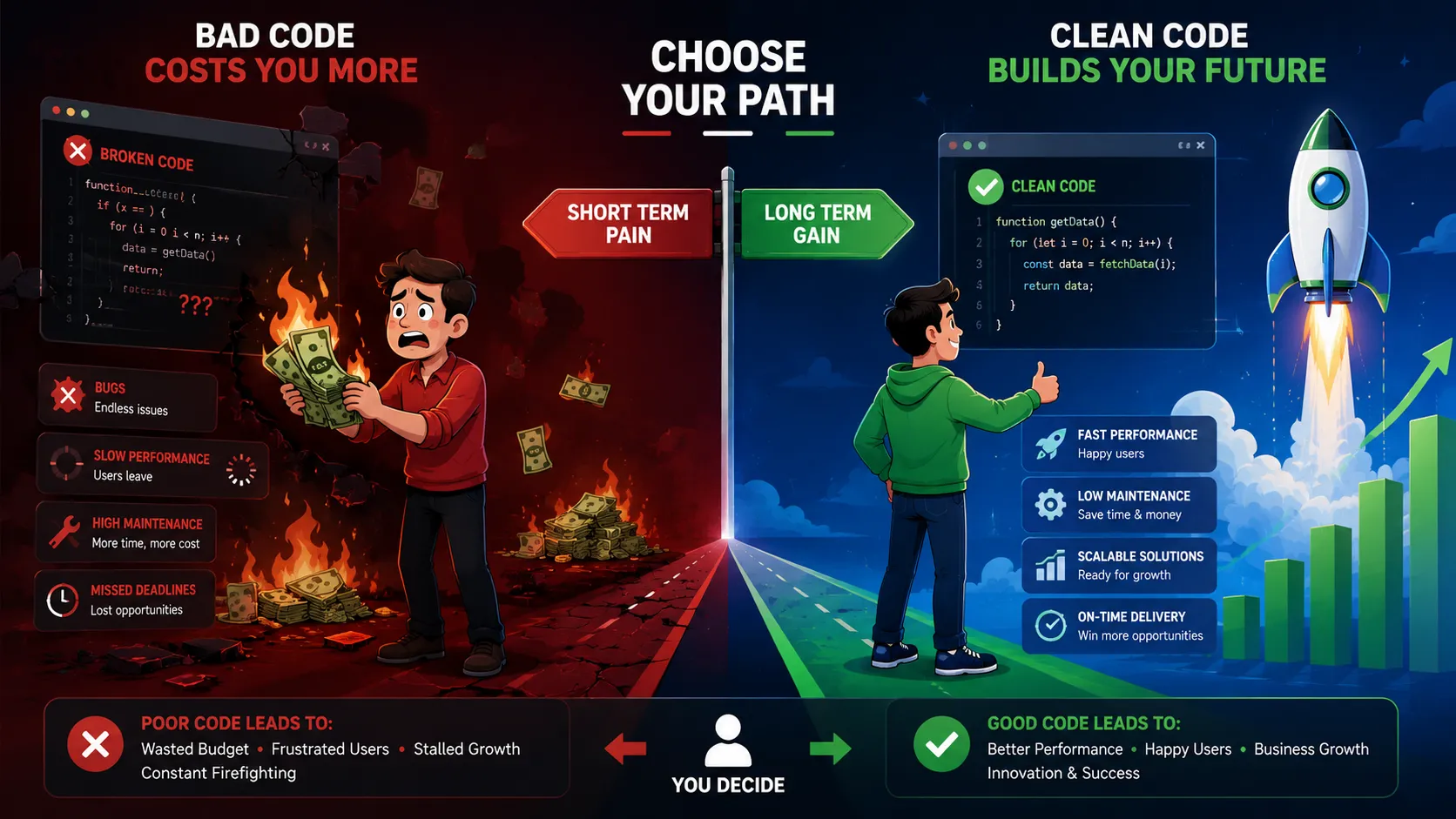
How to Build an MVP Without Wasting $10,000 on the Wrong Tech Stack
Let me tell you about a founder who spent $50,000 building an MVP. Eighteen months later, they had to spend another $120,000 rebuilding it from scratch because the architecture couldn't handle more than 500 users.
That founder is not alone. 60% of MVPs fail to scale due to weak foundations, often requiring a total rebuild within 18 months.
If you are a non-technical founder, you are probably thinking: "I just need to validate my idea. I'll worry about scalability later." That is exactly the mindset that costs startups six figures.
Here is the hard truth: Your MVP is not a throwaway prototype. It is your first production system — the base that early customers rely on and the code that future teams must extend under pressure.
In this guide, I will show you exactly how to build an MVP without wasting money on the wrong tech stack. No jargon. No fluff. Just practical advice for non-technical founders.
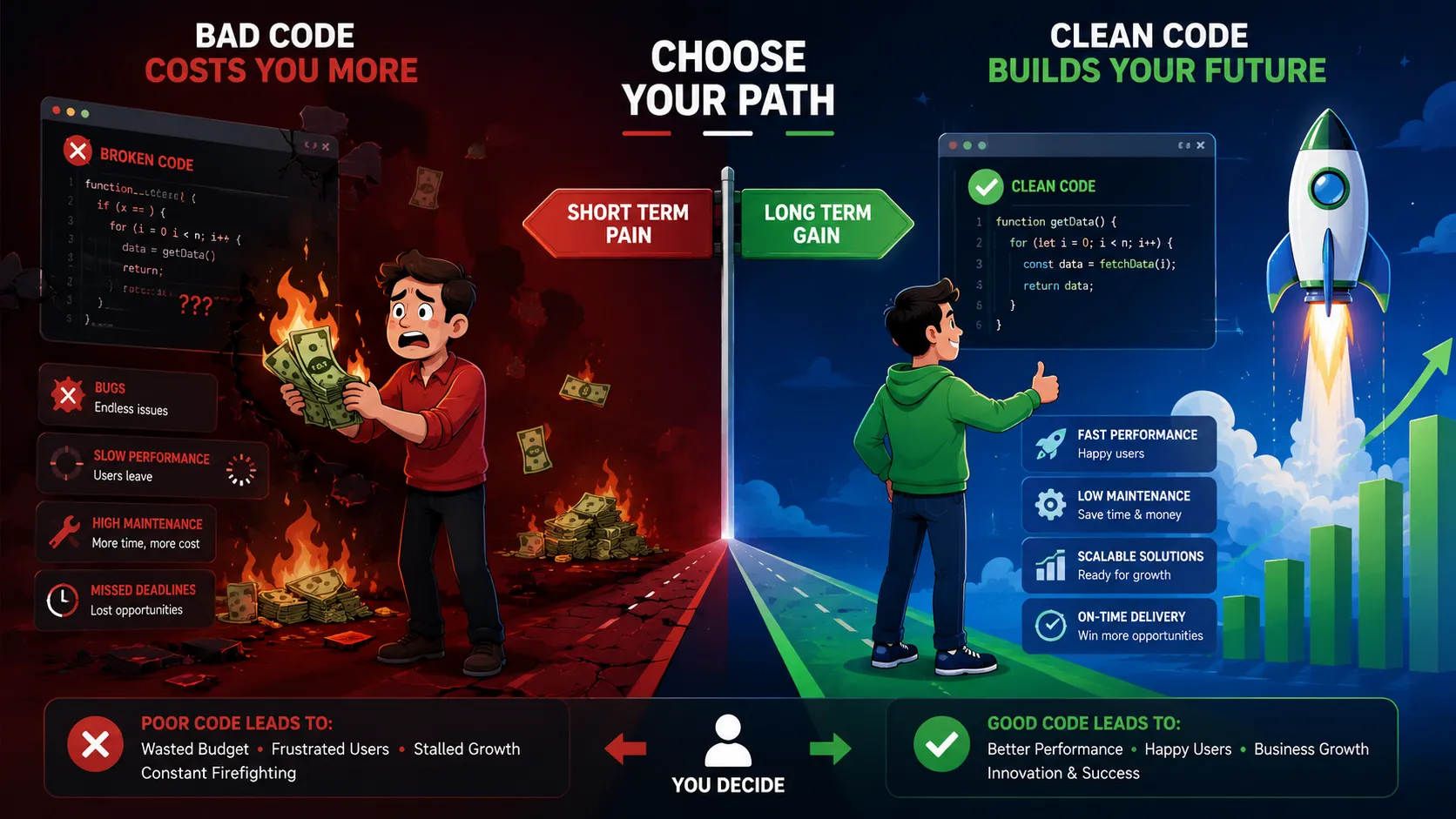
Image: The right architecture saves you from costly rebuilds down the road.
The Real Cost of Getting It Wrong
Here is what most founders don't realize: The real cost of an MVP isn't what you pay to build it. It's what you pay to scale it.
When you choose the wrong architecture, you are signing up for:
- The Rebuild Tax: Emergency rebuilds typically cost 2–3x the original budget ($50k–$250k+) and increase long-term ownership costs by 15–25%.
- Missed Market Windows: While you are rebuilding, competitors are capturing your market.
- Investor Skepticism: A rigid MVP with technical debt signals poor strategic thinking.
- Velocity Decay: Simple tasks that should take hours take weeks of remediation.
- Customer Churn: Performance issues can spike customer churn by 20–30%.
The good news? Investing roughly 10–20% of your initial effort in architecture can reduce long-term remediation costs by over 50%.
What Is an MVP (And What It Is NOT)
Before we talk about tech stacks, let us get clear on what an MVP actually is. Most founders get this wrong — and it costs them dearly.
An MVP IS:
- A tool to test a specific assumption
- A learning mechanism with real users
- A way to reduce risk before you go all in
- A working, deployable application that delivers real value to a real customer segment
An MVP is NOT:
- A "lite version" of your final product
- A demo to impress investors
- A shortcut that skips strategic thinking
- A prototype or proof of concept
As one startup expert put it: "If your first version doesn't make you slightly uncomfortable, you built too much."
The sweet spot is a product that is stripped of anything non-essential, but polished enough to convert skeptical early users and generate trustworthy retention signals.
Common MVP Mistakes That Drain Your Budget
Founders don't fail because they built the wrong MVP. They fail because they misunderstood what an MVP was supposed to do in the first place.
Mistake #1: Building Too Many Features
Founders love features. Adding more feels productive. It feels like progress. It's usually neither.
Feature creep rarely comes from incompetence. It comes from anxiety. The thinking goes: "What if users don't see the value? Let's add one more thing."
Five months later, you have a bloated product that still hasn't answered a single important question about the market.
What works instead: Define one hypothesis. Build only what's needed to test it. Every feature that doesn't serve that test goes on the backlog until you've earned the need to build it.
Rule of thumb: If a feature does not help you answer whether people will pay for it, use it regularly, or recommend it to others — it probably does not belong in your MVP.
Mistake #2: Skipping Market and Customer Validation
This is the most common reason for startup MVP failure.
Building feels faster than talking to people. So teams skip the interviews, trust their instincts, and jump straight into development.
What works instead:
- Talk to at least 15–20 people who match your target market profile. They should be strangers, not supporters.
- Document what people do, not what they say they'd do.
- Get early signals of demand: a waitlist, pre-orders, letters of intent, or people who have already paid you something.
Mistake #3: Choosing Trendy Over Proven Technologies
Every engineer you speak to will have an opinion about what tech stack you should use.
They will recommend their favorite framework, the latest trend, or the language they know best. Meanwhile, you are wasting weeks debating frameworks that all work fine.
What works instead: Choose boring, proven, mainstream technology. The right answer is rarely the trendiest tool; it is the one your team can ship with this month and hire for next quarter, that does not collapse the first time you get real traffic.
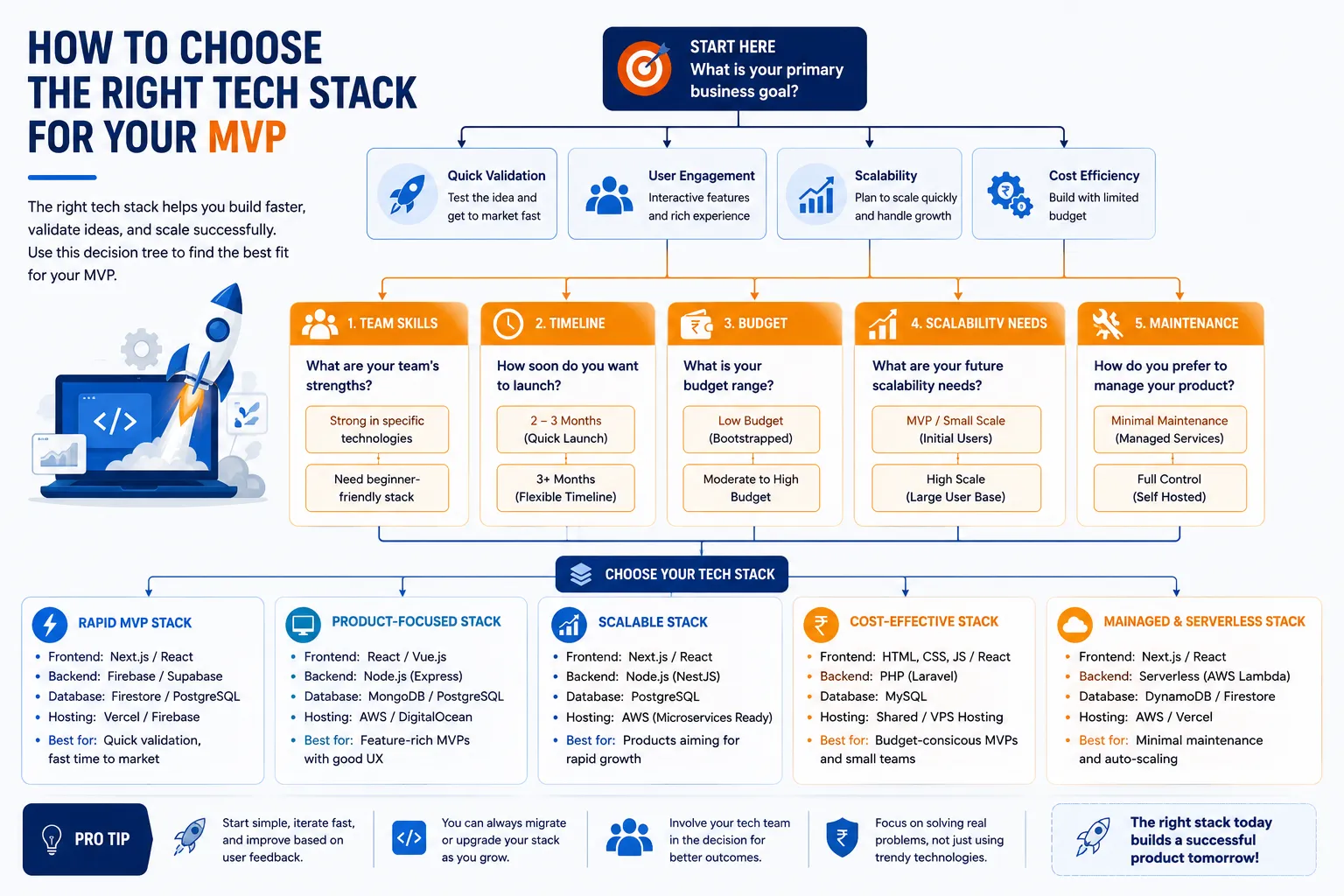
Image: Five criteria that determine whether a tech stack is right for your MVP.
The 2026 MVP Tech Stack: What Actually Works
Choosing a tech stack for an MVP is not a technical decision. It is a product decision with technical constraints.
Five things determine whether a tech stack is right for an MVP: time to first working feature, integration compatibility, team capability, platform ceiling, and migration path.
Here is a practical breakdown:
Frontend: Next.js + TypeScript
For most MVPs, the frontend decision is straightforward: React, delivered through Next.js. React has the largest component ecosystem and talent pool of any frontend technology.
Next.js wraps it with routing, server-side rendering, API routes, image optimization, and first-class deployment.
Pair it with TypeScript from day one. The small upfront cost of types pays for itself the moment your app grows past a few screens — catching bugs before they ship and making refactors safe.
Backend: Node.js or Python/FastAPI
The backend choice in 2026 is usually between a TypeScript/Node backend and Python with FastAPI. Both are mature, have deep talent pools, and handle most MVP workloads well.
Choose Node.js if: Your team already knows JavaScript/TypeScript and you want to share code between frontend and backend.
Choose Python/FastAPI if: Your product requires significant AI/ML capabilities, as Python has the deepest ecosystem for AI.
Database: PostgreSQL (via Supabase)
PostgreSQL is the default choice for most MVPs. It is reliable, proven, and handles real production workloads.
Using Supabase gives you a managed PostgreSQL instance with built-in authentication, real-time features, and storage — saving weeks of development time.
Hosting: Vercel or AWS
Vercel offers the fastest path to deployment for Next.js apps. AWS provides more flexibility for complex needs.
Auth, Payments, and File Uploads: Don't Build Them Yourself
Auth, payments, file uploads, real-time updates, role-based access, and form-based workflows are features that every platform has already built.
Building them from scratch at the MVP stage is sunk cost dressed up as engineering.
Use managed services like Firebase Auth, Supabase Auth, Stripe, and Uploadcare instead of building custom solutions.
How Much Should You Spend on an MVP in 2026?
Here are realistic cost ranges for 2026:
- Simple MVP (no backend, static content, 3–5 screens): $3,000–$8,000
- Standard MVP (auth, database, 8–15 screens, basic API integrations): $8,000–$25,000
- Complex MVP (multi-role permissions, payments, real-time, 20+ screens): $25,000–$60,000
- Full SaaS MVP (production-ready with billing, dashboard, admin tools): $40,000–$100,000
In India, MVP development costs are even more competitive:
- Simple MVP (3–5 screens): ₹3,000–₹8,000
- Standard SaaS MVP: ₹15,000–₹35,000
- Complex Product: ₹35,000–₹80,000
The "Ship in 90 Days" Framework
Here is a practical roadmap for non-technical founders:
Week 0: Problem Definition
- Write the problem your product solves in one sentence, without using the word "platform"
- Talk to 15–20 potential users who experience that problem
- Define what "this MVP is working" means in a measurable metric
Weeks 1–3: Design & Stack Setup
- Wireframe the critical path — the core user journey
- Set up your tech stack (Next.js, Supabase, Vercel)
- Set up authentication, database, and basic hosting
Weeks 4–10: Build the Core Workflow
- Build only what's needed to test your one core hypothesis
- Skip settings pages, admin panels, and nice-to-have features
- Use AI tools (Cursor, Claude) to accelerate development
Weeks 11–12: Launch & Learn
- Get the MVP in front of real users
- Measure user behavior, not just what they say
- Iterate based on feedback — or pivot
Key Takeaways for Non-Technical Founders
1. Don't overbuild. Your MVP is not a full product. It is the smallest thing that can answer your key question. If your first version doesn't make you slightly uncomfortable, you built too much.
2. Validate before you build. Talk to 15–20 strangers who match your target market. Get real signals of demand before spending a dime on development.
3. Choose boring tech. Pick proven, mainstream tools with deep talent pools. Next.js, TypeScript, PostgreSQL, and Node.js/Python are safe bets.
4. Don't build auth, payments, or file uploads from scratch. Use managed services like Supabase, Stripe, and Firebase. Building these yourself at the MVP stage is wasted engineering time.
5. Think about scalability from day one. Not by over-engineering, but by choosing a stack that can grow with you. Investing 10–20% of your initial effort in architecture saves you 50%+ in remediation later.
6. Work with experienced developers who use AI tooling. AI tools like Cursor and Claude can reduce boilerplate coding time by 70–80%, letting engineers focus on architecture and product decisions.
Final Thoughts
Building an MVP is one of the most critical phases of your startup journey. Get it right, and you validate your idea without burning through your runway. Get it wrong, and you join the 60% of startups that fail to scale due to weak foundations.
The good news? You don't need to be a technical founder to make smart decisions. You just need to understand the principles: define one hypothesis, validate with real users, choose boring tech, and think about scalability from day one.
The best Indian MVP development firms aren't just competing on price — they're competing on engineering depth, product thinking, and delivery track records that hold up when you actually look closely.
Ready to build your MVP the right way? Connect with WebStudioLabs today and let us help you choose the right architecture, avoid costly mistakes, and launch a product that actually scales.
WebStudioLabs covers the latest in startup development, MVP strategies, and technology trends. Bookmark us for more insights on building products that matter.
Check out our complete guide to MVP development services here
Have Questions or Need Custom Features?
Connect directly with Rishi Koushal (10+ years engineering experience). Get instant technical support, code customizations, or project estimates on WhatsApp.